How did our ancestors move through the trees?New News Story
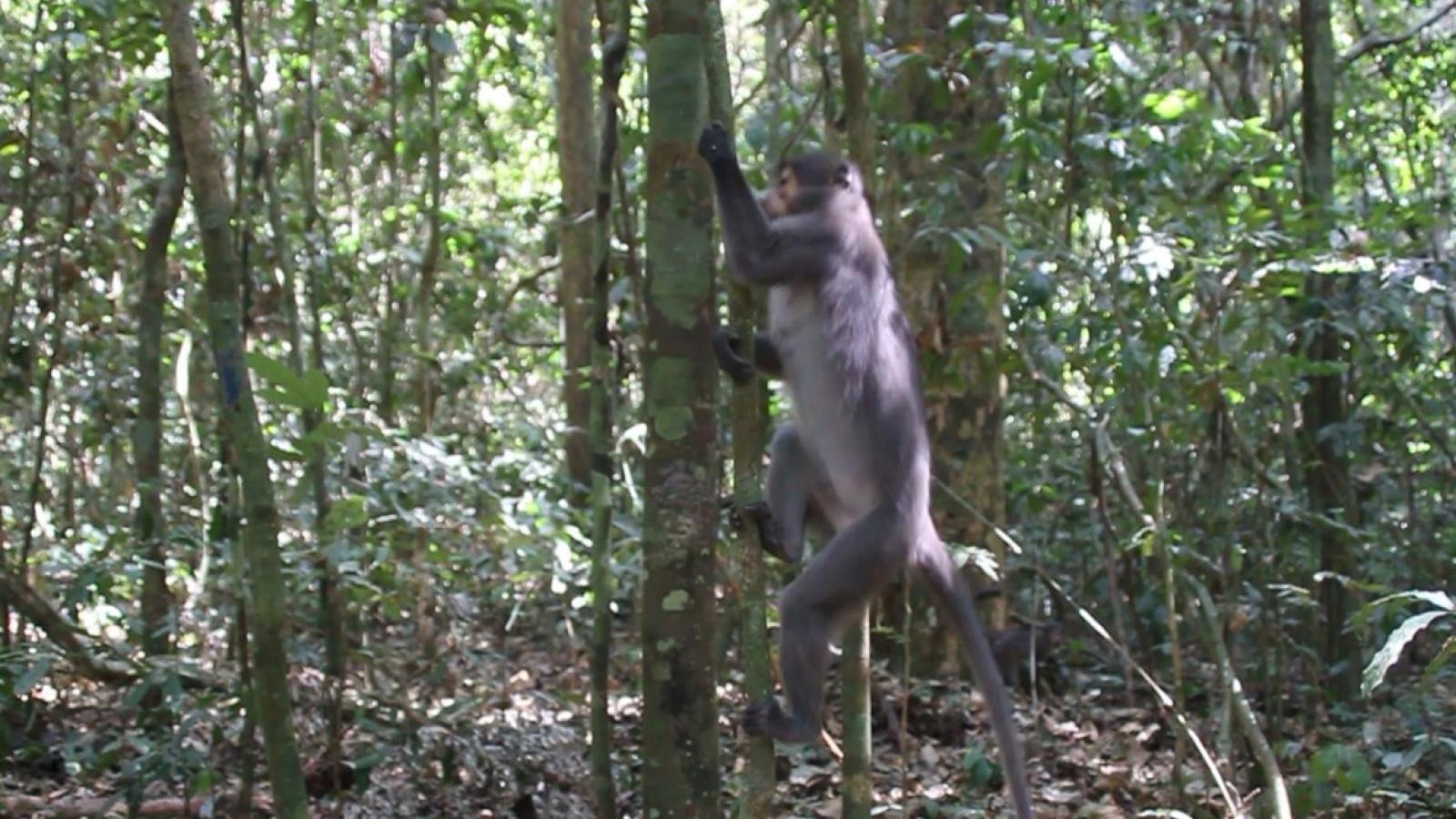
New research from The Ohio State University Department of Anthropology sheds new light on one of the biggest questions in human evolution: How did our earliest ancestors move through the trees?
In a study published in the Proceedings of the National Academy of Sciences based on observations of wild sooty mangabeys in Taï National Park, Côte d'Ivoire, researchers discovered that these monkeys use an exceptionally flexible midfoot while climbing vertical tree trunks. Despite having feet that differ anatomically from chimpanzees, mangabeys achieve nearly the same climbing performance through a different biomechanical solution.
The findings suggest that early human ancestors with more monkey-like feet may also have been effective vertical climbers, offering new insight into the evolution of locomotion before habitual bipedalism.
The study was authored by Luke Fannin, incoming Assistant Professor in the OSU Department of Anthropology, Carmen Pape, a recent OSU Anthropology graduate, and Scott McGraw, Professor and Chair of the Department of Anthropology. Their work highlights the value of long-term field research in Taï National Park and the important contributions of undergraduate researchers to cutting-edge scientific discovery.
Congratulations to Luke, Carmen, and Scott on this exciting contribution to evolutionary anthropology!