Nature Study Reveals the Structural Secret Behind Tooth Enamel's Strength
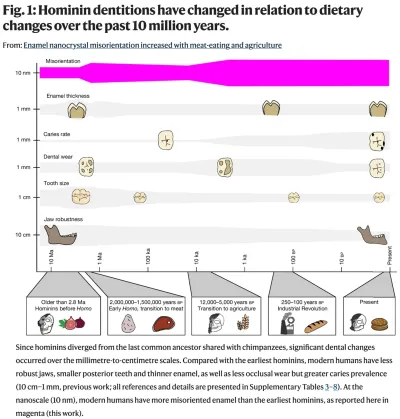
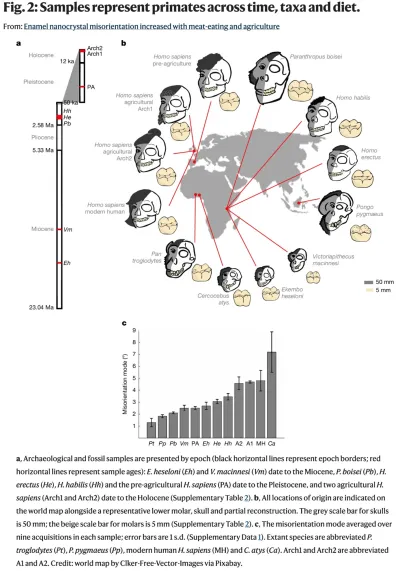
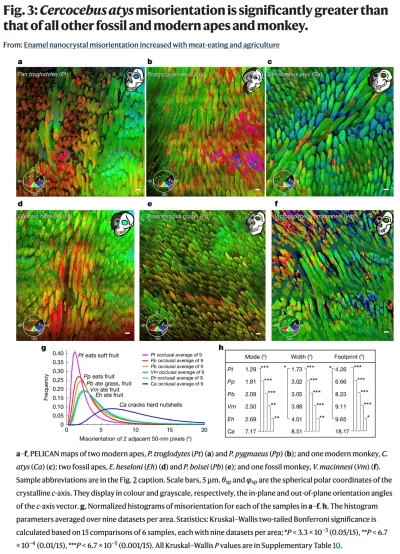
A team of scientists that includes four OSU anthropologists - Mackie O’Hara, Emma Lagan, Debbie Guatelli-Steinberg, and Scott McGraw - published a paper in the prestigious journal Nature showing that the durability of tooth enamel—the toughest substance in our bodies—depends heavily on the messy alignment of its microscopic crystals, which evolved in response to what our ancestors ate. Enamel is made of tiny mineral crystals that bundle together into rods, and the team found that in primates who eat hard, tough foods (like nuts or meat), these crystals are naturally misaligned and angled against each other. This strategic "misorientation" acts as a structural defense mechanism that stops cracks from spreading through the tooth. By examining non-human primate (e.g., sooty mangabeys in the Tai Forest) and hominin (e.g., Paranthropus boisei, Homo erectus, Homo habilis, Homo sapiens) teeth spanning 18 million years, the team discovered that crystal misalignment increased when early humans switched to eating meat, changed again with the birth of agriculture, and rose further with industrial food processing. Ultimately, while human teeth became smaller over time due to cooking making food softer, our enamel crystals adapted to become more misaligned to handle a highly varied, gritty, and flexible modern diet. Here are three figures from the paper.
Anthropology researchers co-author Nature paper on tooth evolution