Ohio State doctoral candidate Samantha Kirgesner earns prestigious Big Ten Academic Alliance Smithsonian Fellowship
Samantha Kirgesner, a doctoral candidate in anthropology at The Ohio State University, has received a highly competitive Big Ten Academic Alliance Smithsonian Fellowship(opens in new window), earning a 12-month appointment at the Smithsonian’s Museum Conservation Institute(opens in new window) in Suitland, Maryland. She will be advised by Timothy Cleland, PhD, a physical scientist at the institute. The fellowship supports advanced doctoral research at Smithsonian facilities and provides scholars with access to world-class collections, laboratories and scientific expertise.
The Big Ten Academic Alliance Smithsonian Fellowship is awarded to doctoral candidates who have advanced to candidacy and are completing dissertation research aligned with Smithsonian priorities. Through the partnership, fellows conduct research in residence at Smithsonian museums and research centers while collaborating with leading experts in their fields.
For Kirgesner, the appointment represents the next step in a career dedicated to advancing archaeological science and cultural heritage preservation.
A University Fellow in Ohio State’s Department of Anthropology(opens in new window), Kirgesner earned a bachelor’s degree in anthropology with a concentration in archaeology and a minor in chemistry from Kent State University before completing a Master of Arts degree in anthropology at Ohio State. Her research focuses on developing minimally destructive, cost-effective methods of ancient protein analysis to identify highly fragmented skeletal remains. Through the use of proteins, otherwise unidentifiable skeletal material can be identified to its species of origin, particularly separating human from non-human remains.
The fellowship places Kirgesner at an institution uniquely suited to support that work. The Smithsonian’s Museum Conservation Institute serves as the center for specialized technical collections research and conservation across Smithsonian museums and collections. The institute combines advanced scientific instrumentation with expertise in cultural heritage preservation, conservation science and technical analysis of anthropological, biological and historical materials. Its capabilities include biomolecular research and mass spectrometry, technologies that align closely with Kirgesner’s scholarly interests.
Her dissertation research recently received additional recognition through an Ohio State Alumni Grant for Graduate Research and Scholarship. The project seeks to refine methods for analyzing collagen proteins in fragmented bone remains, allowing researchers to distinguish human from nonhuman skeletal material while minimizing damage to valuable archaeological collections. The work has important implications for the care and identification of Native American Graves Protection and Repatriation Act-compliant collections and efforts to assist in repatriation processes. For the research, Kirgesner works as graduate researcher in the Badu Research Group in Ohio State’s Department of Chemistry and Biochemistry(opens in new window), conducting mass spectrometry analyses using multiple analytical approaches to minimize sample preparation and reduce analysis costs.
Her accomplishments extend beyond the laboratory. Kirgesner has built a record of interdisciplinary scholarship that combines archaeology, anthropology and scientific analysis. As a master’s student, she earned the Department of Anthropology’s Outstanding Master of Arts Thesis Award for 2021-22, recognizing the quality and impact of her graduate research.
She also has shared her work widely through professional conferences and university research forums. At Ohio State’s Hayes Research Forum, Kirgesner presented her master’s research examining long-term human-environment interactions through the study of ancient mollusk foraging in Fiji. More recently, she contributed to research presented at the Society of Ethnobiology, exploring connections among microbiology, archaeology and community-based Hawaiian fishpond restoration. Kirgesner has also presented parts of her dissertation research at the Society for American Archaeology, American Society for Mass Spectrometry, American Association of Biological Anthropologists, and the International Society for Biomolecular Archaeology.
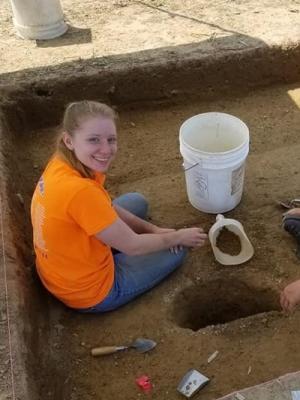
Kirgesner was a cultural resource intern in the Office of Environmental Services at the Ohio Department of Transportation (ODOT) during her graduate career. As an intern, she assisted with archaeology and history/architecture evaluations for Section 106 impacts for ODOT projects across the state. She also assisted in the office’s various public outreach activities to teach about the importance of cultural resource management. Her time at ODOT has developed a commitment to foster collaborations between public archaeology and academia to best protect archaeology and cultural heritage.
The Smithsonian fellowship will provide an unparalleled environment for that work to continue. Through access to specialized instrumentation, conservation scientists and Smithsonian collections, Kirgesner will have opportunities to advance research that could improve the identification and preservation of fragmented skeletal materials and support ethical approaches to cultural heritage management.
As she begins her year at the Museum Conservation Institute, Kirgesner joins a select group of scholars chosen from across Big Ten Academic Alliance institutions. The fellowship recognizes not only her academic achievements but also the growing significance of her research at the intersection of archaeology, science and cultural heritage preservation.
“With this fellowship, I have the opportunity to work with one of the leading experts in my field at the largest research institute in the world, Kirgesner said. “I’m excited for the chance to collaborate and network with other researchers, fellows, and interns across the Smithsonian. It’s also incredible to have my research supported at this level. I’m grateful to my advisors and everyone who has assisted me in my research and application, especially those in the Badu Research Group and my department.”